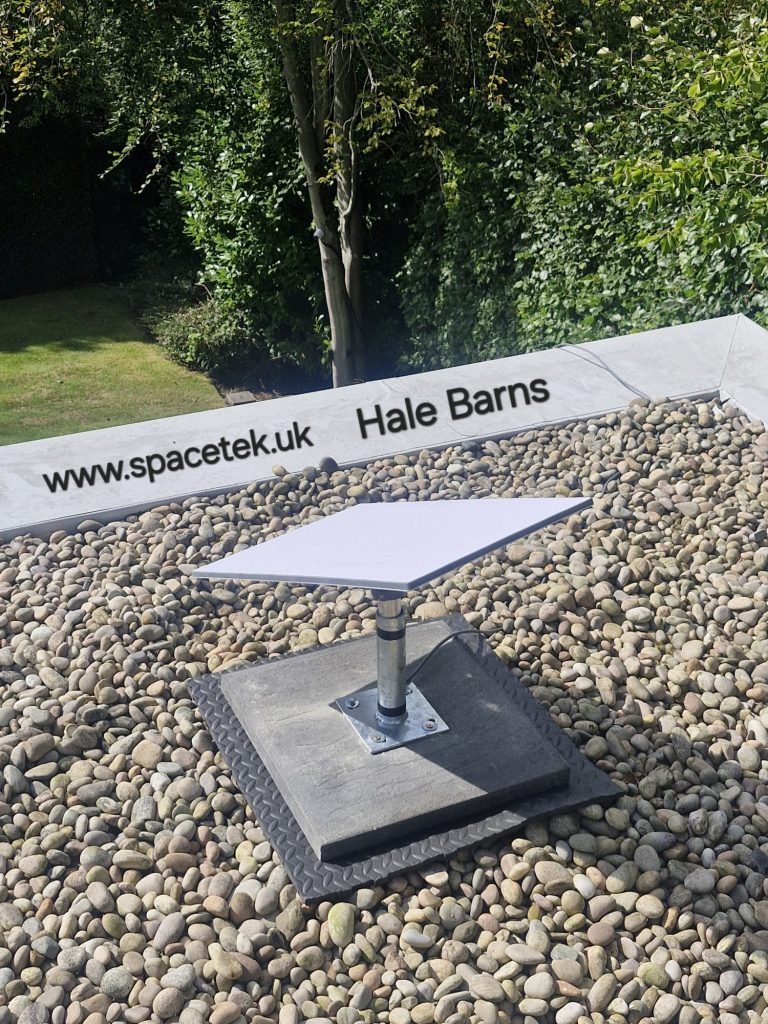
The SpaceTek archive includes this Starlink installation in Hale Barns, showing a low support above slabs and a protective mat on a gravel-covered roof. It offers a useful starting point for discussing a flat-roof installation, but the visible components are not a recipe to reproduce on another roof.
Begin with the roof, not the dish
Identify the roof construction, surface and any warranty or maintenance requirements. Ask the owner or responsible roof specialist what restrictions apply before choosing a mounting arrangement. The support, its loading and the way it contacts the surface need assessment together.
Do not infer a required slab weight or wind resistance from the photograph. Those details depend on the particular assembly, position and building. An arrangement intended to avoid penetrations still needs appropriate design and inspection.
Keep drainage and access in the conversation
Show the proposed position in relation to roof outlets, access points and equipment that maintenance staff need to reach. Discuss how cables and supports will avoid obstructing those routes. A location that appears tidy in a close-up may be awkward when the wider roof is considered.
Ask who will inspect the installation after roofing work and how the assembly can be moved by the appropriate people if repairs are needed. Keep those responsibilities in the handover information.
Assess the view from the proposed position
Trees are visible around the roof in the archive image. Their presence is a reason to assess the view from the intended dish position, not evidence that the installation is obstructed. The relevant assessment is made for the actual position and equipment.
Where vegetation or neighbouring structures affect a candidate position, compare alternatives before committing to a support. Increasing height or changing location can have consequences for the roof arrangement and cable route.
Carry the plan through to the house
Identify where the cable leaves the roof, enters the building and connects indoors. Agree how it remains supported and accessible without becoming a loose obstacle for future maintenance. The indoor location should follow the network requirements rather than simply the nearest convenient opening.
For a different local approach, compare the Hale gable-side installation. The two examples demonstrate why SpaceTek assesses the property before specifying the mounting method.
Related Hale Barns guides
Discuss your Hale Barns installation
Send SpaceTek your postcode, equipment details and property photos or call Bob on 07802 410 222. SpaceTek UK is an independent installer; Starlink service and subscription arrangements are separate.